
Feimu helps industrial automation buyers source essential control system components, including the Allen Bradley 1785-ENET Ethernet Interface Module, designed to add Ethernet communication capabilities to compatible PLC-5 controllers. Understanding its specifications, installation requirements, and compatibility is essential for maintaining dependable communication in legacy automation environments.
The Allen Bradley 1785-ENET is an Ethernet interface module developed for compatible Allen-Bradley PLC-5 control systems. It enables communication between supported controllers and host computers through TCP/IP Ethernet, helping industrial facilities integrate legacy equipment with supervisory systems and engineering workstations. This guide explains its operating principles, major features, technical specifications, application scenarios, installation considerations, and purchasing checks. Because the manufacturer discontinued the module in 2017, buyers should pay particular attention to product authenticity, hardware revision, compatibility, and the availability of technical support before placing an order.
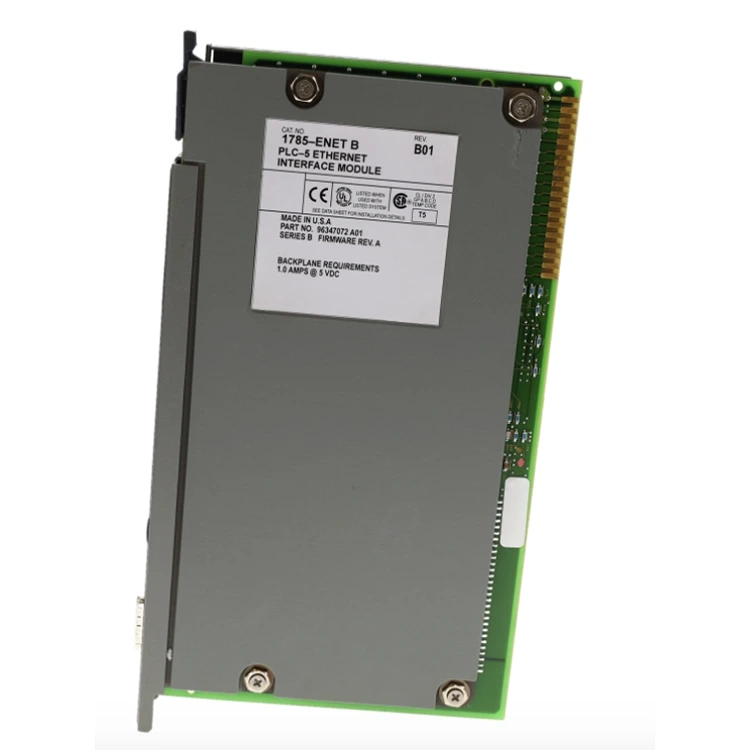
The Allen Bradley 1785-ENET is a PLC-5 Ethernet Interface Module from the Allen-Bradley product family associated with Rockwell Automation. Its primary purpose is to provide Ethernet communication capabilities for supported PLC-5 processors, allowing industrial control equipment to exchange data with other controllers and host computers over a TCP/IP network.
In established manufacturing facilities, PLC-5 controllers may still operate essential production processes. Replacing an entire control platform can involve substantial engineering work, equipment costs, downtime, and validation requirements. Adding a compatible communication interface can therefore be a practical option when an existing system needs network connectivity and continued operation is a priority.
The 1785-ENET is designed to attach to a compatible PLC-5 processor using a dedicated connector arrangement. It communicates through processor channel 3A rather than operating as a conventional standalone Ethernet adapter on the 1771 I/O backplane.
According to the manufacturer's product information, the module was discontinued on May 18, 2017. Consequently, it is particularly relevant to legacy system maintenance, spare-parts replacement, and existing PLC-5 installations rather than new automation projects that require a current-generation platform.
For additional technical details, consult the official 1785-ENET product page and the PLC-5 Ethernet Interface Module user manual.
The module provides an Ethernet communication path for supported PLC-5 processors. This allows the controller to exchange information with compatible host computers and other networked control equipment without requiring an immediate replacement of the entire automation architecture.
TCP/IP networking supports communication between industrial controllers and computer-based applications. Depending on the system configuration and software compatibility, engineers can use the communication interface for controller messaging, data access, diagnostics, and selected supervisory functions.
Legacy plants frequently combine programmable controllers, operator interfaces, engineering workstations, and supervisory applications. The 1785-ENET can help connect supported PLC-5 equipment to an Ethernet-based infrastructure while preserving established control processes.
The manufacturer's technical documentation lists support for up to 64 simultaneous connections per module. The actual communication capacity available to an application depends on the network design, controller configuration, software, and the demands of connected devices.
The documented platform includes network-management capabilities such as Simple Network Management Protocol (SNMP), together with diagnostic functions described in the product manual. These features can help maintenance teams investigate communication conditions and manage established network configurations.
Before purchasing an Allen Bradley 1785-ENET, buyers should compare the product identification, physical interface, electrical requirements, and installation arrangement with the existing control system. The following table summarizes reference specifications documented for the original PLC-5 Ethernet Interface Module.
| Specification | Reference Information |
|---|---|
| Catalog Number | 1785-ENET |
| Product Type | PLC-5 Ethernet Interface Module |
| Product Family | Allen-Bradley PLC-5 |
| Communication Protocol | Ethernet using TCP/IP |
| Communication Channel | Processor channel 3A |
| Original Ethernet Interface | 15-pin AUI transceiver port |
| Simultaneous Connections | Up to 64 per module |
| Unsolicited Definitions | Up to 512 per module, as documented |
| Backplane Current | 2.2 A, according to the original user manual |
| Heat Dissipation | 37.54 BTU/hour, according to the original user manual |
| Operating Temperature | 0°C to 60°C (32°F to 140°F) |
| Storage Temperature | -40°C to 85°C (-40°F to 185°F) |
| Relative Humidity | 5% to 95%, non-condensing |
| Approximate Weight | 0.95 kg (2.1 lb) |
| Manufacturer Lifecycle Status | Discontinued |
Technical note: These figures refer to the documented 1785-ENET hardware. Different catalog suffixes or hardware revisions may have different physical interfaces or specifications. In particular, do not assume that every product advertised as 1785-ENET has an RJ45 port or supports the same connection method. Verify the exact unit against its nameplate and the applicable manufacturer documentation before ordering or installation.
The Allen Bradley 1785-ENET is most relevant where a compatible PLC-5 controller remains part of an established automation system. Its value depends on the communication requirements of the application and the condition of the surrounding infrastructure.
Production lines may rely on PLC-5 controllers to coordinate conveyors, machine sequences, sensors, and actuators. Ethernet connectivity can help transfer operational data to compatible supervisory computers, supporting monitoring and troubleshooting without automatically requiring a complete control-system replacement.
Industrial facilities often collect controller information for centralized monitoring. Where the controller, software, and network configuration are compatible, the interface can support data exchange with host applications used to review equipment status and process conditions.
For factories operating older machinery, maintaining an existing communication architecture may be necessary while a long-term migration plan is developed. A suitable replacement module can help address a failed component, provided that its hardware revision and compatibility are confirmed.
Engineers may need to access controller information during commissioning, diagnostics, or scheduled maintenance. A correctly configured Ethernet link can provide a communication route for supported engineering tools and controller messaging functions.
In each case, the module should be treated as one component of a larger communication system. Network segmentation, access control, software compatibility, and documented recovery procedures remain important for reliable industrial operation.
Correct installation is essential for dependable communication and protection of legacy controller hardware. Qualified automation personnel should consult the applicable user manual before installing or replacing the module.
Never force a connector into place or assume that an Ethernet cable can connect directly to the module without the required transceiver. The original user manual identifies a 15-pin AUI interface, so the appropriate physical connection must be confirmed for the exact unit being installed.
For further instructions, refer to the manufacturer's installation and configuration manual.
Because the Allen Bradley 1785-ENET has been discontinued, procurement requires more than comparing catalog numbers and quoted prices. Buyers should evaluate the part's suitability for the intended system and the supplier's ability to provide clear product information.
Request clear photographs of the product label and connectors. Verify whether the item is the original 1785-ENET or a related version with a different suffix. Do not rely on a generic product photograph or a listing title alone.
Clarify whether the offered unit is new old stock, used, refurbished, or repaired. Ask what inspection or functional testing has been performed, whether serial or catalog information can be documented, and what warranty terms apply to the specific item.
Provide the supplier with the PLC-5 processor model, current hardware revision, intended communication setup, and any relevant installation constraints. These details help determine whether the offered module is appropriate for the application.
For a discontinued component, delivery commitments, return conditions, technical assistance, and replacement options may be as important as the purchase price. Confirm these terms in writing before issuing a purchase order.
A practical procurement checklist includes:
Feimu can be contacted to discuss sourcing requirements for the Allen Bradley 1785-ENET and related industrial automation components. Buyers should provide their application details so product availability, condition, and compatibility can be reviewed before an order is finalized.
The 1785-ENET is an Ethernet interface module for compatible PLC-5 controllers. It provides TCP/IP communication capabilities that can connect supported controllers with other PLC-5 devices and host computers.
No. Rockwell Automation lists the 1785-ENET as discontinued, with a discontinuation date of May 18, 2017. Buyers generally need to investigate available legacy stock, repair options, or an engineering replacement suitable for their application.
The original module documentation identifies Ethernet communication through a 15-pin AUI transceiver port. Buyers should check the exact catalog suffix and hardware revision because related versions may use different physical interfaces.
No. Compatibility depends on the specific processor family, catalog number, series, firmware, and installation arrangement. Consult the manufacturer's compatibility information and user manual before purchasing a replacement.
Verify the catalog number, revision, physical connectors, product condition, compatibility, testing records, warranty, and delivery terms. For a discontinued part, obtaining clear photographs and written confirmation of the offered unit is particularly important.
It may support integration with an Ethernet-based network when the controller, communication software, physical interface, and network configuration are compatible. However, it should not be assumed to support every modern protocol or network feature. Evaluate the complete system requirements before implementation.
The Allen Bradley 1785-ENET remains a relevant component for selected legacy PLC-5 installations that require Ethernet communication. Understanding its TCP/IP capabilities, original AUI interface, electrical specifications, installation requirements, and discontinued lifecycle status helps maintenance teams make better technical and procurement decisions. Careful compatibility checks and documented testing can reduce the risks associated with replacing older industrial automation hardware.
If you are sourcing the Allen Bradley 1785-ENET or looking for compatible PLC-5 components, Feimu is ready to discuss your requirements. Share your catalog number, controller model, required quantity, and delivery destination to help clarify available options and technical considerations. Please contact us for product availability inquiries, quotations, and assistance with your industrial automation spare-parts sourcing needs.