
Article Summary: The Allen Bradley 1762-L40BWA is a 40-point MicroLogix 1200 programmable logic controller (PLC) designed for industrial automation applications that require reliable digital I/O control, relay outputs, and serial communication. Although this controller was discontinued by Rockwell Automation in 2021, it remains relevant to maintenance teams managing existing equipment and businesses evaluating legacy PLC replacement strategies. This guide explains its main specifications, features, applications, selection considerations, and purchasing checks to help industrial buyers make informed decisions.
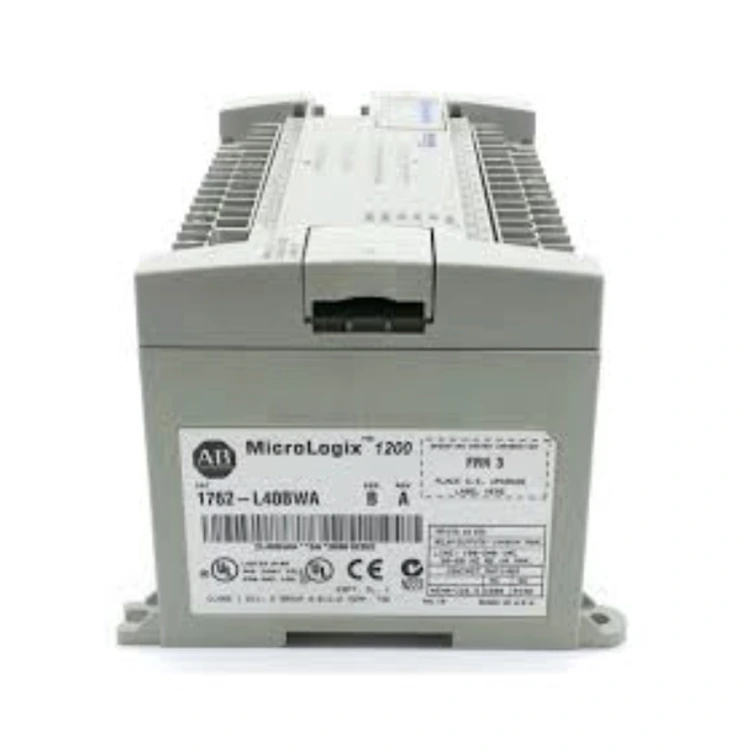
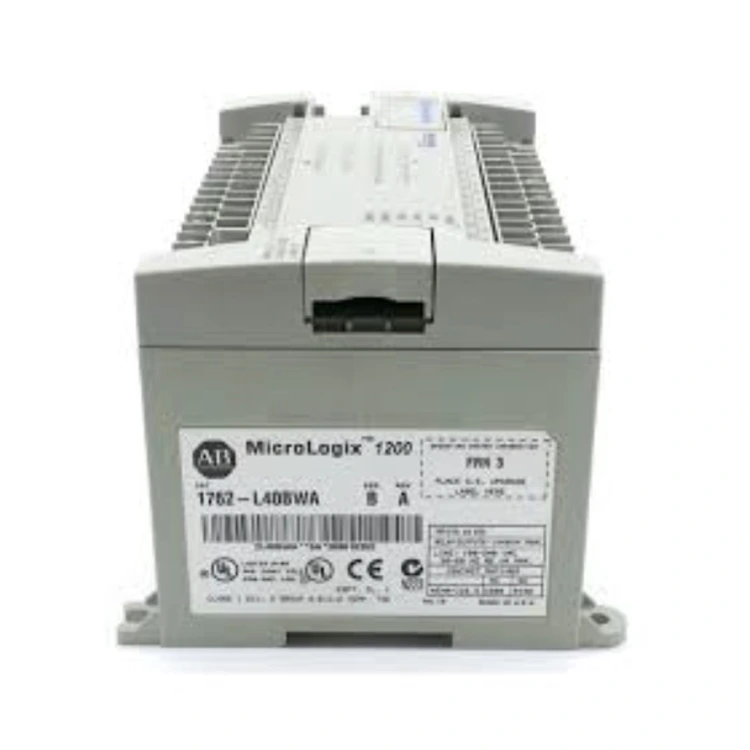
The Allen Bradley 1762-L40BWA is a MicroLogix 1200 programmable logic controller manufactured by Rockwell Automation. For industrial buyers working with Feimu, this model is particularly relevant when maintaining established production equipment, sourcing legacy automation components, or assessing the feasibility of extending an existing control system.
Designed as a compact controller with integrated input and output points, the 1762-L40BWA can execute programmed logic to coordinate sensors, switches, relays, and other control devices. Its onboard I/O reduces the need for separate modules in applications that fit its built-in capacity.
The controller features 24 digital inputs and 16 relay outputs, providing 40 integrated I/O points in total. Its inputs operate with 24V DC signals, while its power supply accepts 120/240V AC. This configuration makes it suitable for various established machine-control systems.
One important purchasing consideration is product lifecycle status. Rockwell Automation lists the 1762-L40BWA as discontinued, with discontinuation effective August 25, 2021. Buyers should therefore verify current availability, product condition, and technical compatibility before placing an order.
For additional technical information, consult the official Allen-Bradley 1762-L40BWA product page.
Reviewing the technical specifications of the Allen Bradley 1762-L40BWA helps engineers determine whether it meets their existing system requirements. The following table summarizes the principal product characteristics.
| Specification | Details |
|---|---|
| Product model | 1762-L40BWA |
| Manufacturer | Allen-Bradley / Rockwell Automation |
| Controller family | MicroLogix 1200 |
| Total onboard I/O | 40 points |
| Digital inputs | 24 inputs: 20 standard and 4 fast 24V DC inputs |
| Digital outputs | 16 relay outputs |
| Power supply | 120/240V AC nominal supply configuration |
| Communication interface | RS-232C serial port |
| Supported communication options | DF1, DH-485, Modbus RTU, and ASCII |
| Memory | 6 KB total memory as listed by Rockwell Automation |
| Dimensions | Approximately 160 × 90 × 87 mm (W × H × D) |
| Operating temperature | 0°C to 55°C under specified operating conditions |
| Lifecycle status | Discontinued |
Note: Specifications should be checked against the manufacturer's documentation for the exact controller revision. Installation dimensions, electrical ratings, communication configuration, and memory details should be confirmed before designing a replacement or modifying an existing panel.
The controller's 24 digital inputs include four fast inputs that can support suitable high-speed input functions. These inputs share resources with certain specialized functions, so engineers should consult the programming and installation manuals before assigning them to high-speed applications.
For further details, refer to the MicroLogix 1200 Programmable Controllers User Manual.
The combination of 24 digital inputs and 16 relay outputs allows the controller to manage multiple field devices without requiring a separate expansion module for every signal. Typical input devices include limit switches, push buttons, and proximity sensors, while outputs can control suitable contactors, indicator lamps, and interposing relays.
This integrated configuration can help simplify control-panel layouts and reduce wiring complexity in appropriately sized applications.
Relay outputs can switch compatible AC or DC loads within the controller's specified electrical ratings. This versatility is useful in equipment where different output circuits require different switching arrangements.
However, relay contacts have voltage, current, switching-frequency, and electrical-life limitations. Inductive loads may require suitable suppression, and loads exceeding the controller's ratings must be operated through properly selected external switching devices.
The four fast digital inputs support applications requiring faster signal recognition than ordinary digital inputs can provide. Depending on the configuration, these resources can support high-speed counting and related input functions.
Engineers should verify input wiring, signal frequency, shared-function restrictions, and program configuration before using these capabilities in counting or position-related tasks.
The onboard RS-232C interface provides a connection point for supported programming and communication arrangements. Depending on the network configuration and appropriate interface equipment, the controller can communicate using supported protocols such as DF1, DH-485, Modbus RTU, and ASCII.
Communication compatibility should be checked carefully when connecting legacy equipment to newer HMIs, supervisory systems, or industrial networks.
The Allen Bradley 1762-L40BWA is most relevant to applications that already use the MicroLogix 1200 platform or require a controller with a matching electrical and I/O configuration.
Actual suitability depends on the number of required signals, program complexity, response-time requirements, electrical loads, environmental conditions, and applicable safety standards. A 40-point PLC is not automatically suitable for every machine with fewer than 40 signals.
For new automation projects, engineers should also consider long-term support, software availability, spare-part sourcing, cybersecurity requirements, and the lifecycle of the wider control system.
Communication is an important factor when integrating a legacy PLC into a broader industrial control environment. The Allen Bradley 1762-L40BWA provides an RS-232C serial interface, and its supported communication options include DF1, DH-485, Modbus RTU, and ASCII.
These capabilities can support communication with compatible programming tools, operator interfaces, and other equipment when the required protocol, cabling, and configuration are available.
Before integration, engineers should verify the following:
Although gateways can help bridge older serial systems and newer networks, they do not automatically make every function or data structure compatible. Communication testing should be completed before the equipment is returned to production.
Because the 1762-L40BWA is discontinued, purchasing decisions require more than a simple comparison of model numbers and prices. Buyers should evaluate the controller's physical condition, authenticity, configuration, and suitability for the intended application.
| Evaluation item | What to check | Why it matters |
|---|---|---|
| Model identification | Confirm the complete 1762-L40BWA catalog number | Prevents ordering a different I/O or power configuration |
| Physical condition | Inspect terminals, housing, connectors, and signs of heat or corrosion | Helps identify visible damage before installation |
| Functional testing | Ask for documented testing appropriate to the supplied condition | Provides more information than appearance alone |
| Accessories | Confirm whether cables, manuals, or other accessories are included | Helps avoid commissioning delays |
| Program compatibility | Verify software, firmware, and project-file requirements | Reduces integration and startup risks |
| Warranty and returns | Obtain written terms from the seller | Clarifies support for a discontinued component |
Industrial buyers should also compare the cost of sourcing a legacy unit with the engineering and downtime costs associated with upgrading to a supported controller. The best choice depends on the criticality of the equipment, remaining service life, available documentation, and the budget for migration.
For sourcing inquiries, Feimu's Allen Bradley 1762-L40BWA product page is a useful starting point for checking product details and requesting current availability information.
Correct installation is essential for the reliable operation of any PLC. Before installing or replacing an Allen Bradley 1762-L40BWA, qualified personnel should review the manufacturer's instructions and the electrical requirements of the complete machine.
Always isolate hazardous energy before wiring or servicing the controller. Never assume that removing a software command or switching the PLC to a particular operating mode makes connected machinery safe. Emergency-stop functions and other safety-related controls must be designed and implemented according to applicable standards and the machine's risk assessment.
For maintenance planning, keep an accurate record of the controller catalog number, installed revision, program backup, wiring diagrams, communication settings, and replacement history. This information can significantly reduce troubleshooting time when a legacy control system experiences a fault.
It is a MicroLogix 1200 PLC from Rockwell Automation with 40 integrated I/O points, consisting of 24 digital inputs and 16 relay outputs.
Yes. Rockwell Automation lists this model as discontinued, effective August 25, 2021. Buyers should confirm availability through their supplier and evaluate long-term support requirements before purchasing.
The model uses a 120/240V AC nominal power-supply configuration. Confirm the permitted input range and installation requirements in the official manual before connecting power.
It has 24 digital inputs designed for 24V DC signals, including four fast inputs, and 16 relay outputs. The fast inputs have specialized functions and configuration requirements that should be checked in the controller documentation.
It can communicate with compatible devices through its RS-232C serial interface when the protocol, cabling, and communication settings are supported. Additional interface equipment may be required for some HMI models or modern networks.
Not necessarily as a direct plug-and-play replacement. Differences in power supply, I/O type, terminal wiring, program compatibility, communication, and physical layout must be evaluated before selecting another controller.
Confirm the exact model, condition, authenticity documentation where available, functional test results, warranty terms, and return policy. Also check whether the unit includes the accessories and documentation required for commissioning.
Start with the official product information and the MicroLogix 1200 user manual. These resources provide important information about specifications, installation, wiring, and supported functions.
The Allen Bradley 1762-L40BWA remains a relevant component for businesses maintaining established MicroLogix 1200 automation systems. Its 24 digital inputs, 16 relay outputs, AC power configuration, and serial communication capabilities make it a practical option for compatible legacy applications. However, its discontinued status means that availability, condition, software compatibility, and future maintenance costs deserve careful consideration.
For industrial buyers, choosing the right supplier is an important part of reducing procurement risk. Feimu can be contacted to discuss product availability, technical details, and sourcing requirements for the Allen Bradley 1762-L40BWA. If you are looking for a suitable controller for maintenance, repair, or replacement planning, visit the product page and contact us to request a quotation and confirm the details needed for your project.